These days, there's even a couple of companies in the USofA that make purpose-built designs based on the rocket stove principle, like this:

This stove uses the rocket stove principle and mixes it with the masonry stove, invented in Sweden at the end of the 1700s. These old stoves are super-efficient by the standards of 'modern' wood-burning stoves, but we just don't seem to have bothered taking them seriously. Many older apartments I've seen in Prague have them, unused, while inefficient and dangerous gas convection heaters are used instead.
Here is a Scottish company that specializes in bespoke masonry stoves, and also installs antique Swedish style kakelungs, or tile stoves, as beautiful as they are efficient and awesome:

The secret of all these designs is in the burning of the combustible gasses in woodsmoke. Not only is this more efficient, giving higher temperatures and more heat per stick, but cleaner too. Obviously the right way of doing it, and a real shame that almost no-one in the UK does.
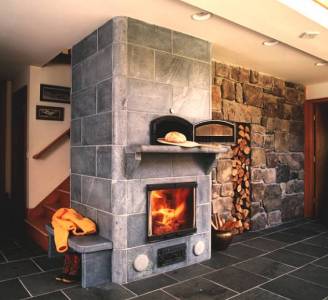
Masonry stoves achieve this by leading the hot air around an insulating thermal mass labyrinth of chambers. There are a lot of lovely images and explanations on this site:

...which can also include a baking oven or bottom-warming bench, for example:
As the above site relates, Mark Twain tried to tell everyone about the German version, the kachelofen, in the 1920s. The fuel economy! The air quality! The convenience! But no, nobody in the English speaking world paid any attention and nearly a century later they're still a mystery.